What
are Labour Law Registrations?
Labour Law Registrations are mandatory
registrations required for businesses and establishments employing workers or
staff. These registrations ensure compliance with employee welfare, social
security, salary, insurance, and labour law regulations under various
government departments.
Why
are Labour Law Registrations required?
Labour law registrations are required to
protect employee rights and ensure employers comply with legal obligations
related to provident fund, insurance, wages, and employee benefits.
Types
of Labour Law Registrations
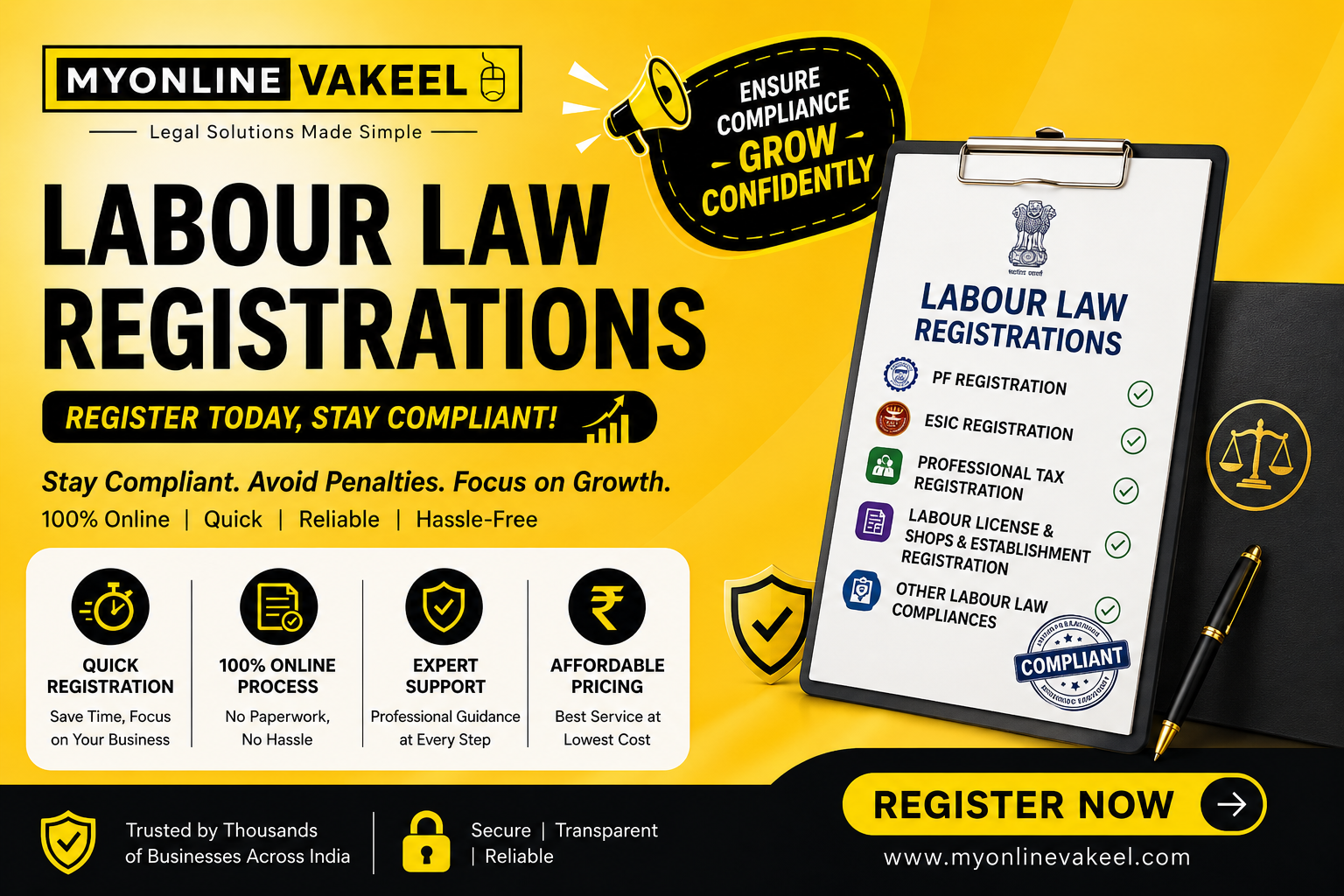
1. EPF
Registration (Employees’ Provident Fund)
Mandatory for establishments
employing the prescribed number of employees to provide retirement and savings
benefits to workers.
2. ESIC
Registration (Employees’ State Insurance Corporation)
Mandatory for eligible establishments to provide medical and insurance
benefits to employees.
3. Labour Welfare Fund Registration
Applicable in certain states for employee
welfare contributions.
4.CLRA Registration
(Contract Labour License)
Required for businesses employing contract
labour workers.
5. Professional Tax Registration
Applicable for employers and professionals under state tax laws.
Who needs Labour Law
Registrations?
1.
Factories
and manufacturing units
2.
Shops
and commercial establishments
3.
Companies
and LLPs
4.
Contractors
and manpower suppliers
5.
Hotels
and restaurants
6.
Service
providers and offices
7.
Businesses
employing workers or staff
Benefits
of Labour Law Registrations
1.
Legal
compliance with labour laws
2.
Employee
social security and insurance benefits
3.
Avoidance
of penalties and legal notices
4.
Better
employee trust and workplace management
5.
Smooth
labour inspections and audits
6.
Required
for tenders and government projects
Documents
Required
1.
PAN
Card of business/entity
2.
Aadhaar
Card of owner/director
3.
Business
address proof
4.
GST
registration certificate (if applicable)
5.
Bank
account details
6.
Employee
details and salary records
7.
Certificate
of incorporation/partnership deed
8.
Electricity
bill and rent agreement (if applicable)
Penalty for Non-Compliance
Failure to obtain labour law registrations or
non-compliance may result in:
1.
Heavy
penalties and fines
2.
Legal
notices and prosecution
3.
Interest
on unpaid dues
4.
Restrictions
on business operations
Process
of Labour Law Registration
1.
Collection
of required documents
2.
Online
application filing
3.
Verification
by concerned department
4.
Registration
approval and certificate issuance
5.
Ongoing
compliance and return filing
Validity
of Registration
Most labour law registrations remain valid
until cancellation; however, regular return filing and compliance are
mandatory.
Why
Choose MyOnlineVakeel?
MyOnlineVakeel provides complete labour law
registration and compliance services including PF registration, ESIC
registration, labour license support, documentation, return filing, and
department follow-ups. We ensure legally compliant and hassle-free services for
your business.
Contact Us
MYONLINEVAKEEL
Bhopal, Madhya Pradesh
Contact: 9669999037
Email: MYONLINEVAKEEL555@GMAIL.COM
Frequently Asked Questions
1. What
is Labour Law Registration?
Labour Law Registration is the process of registering a business under
applicable employment and workforce compliance laws regulated by the Ministry
of Labour and Employment for employee welfare, workplace safety, and legal
compliance.
2. Who
needs Labour Law Registration in India?
Businesses employing workers in factories, offices, shops, construction,
manufacturing, or contract labour arrangements generally require labour law
registration under applicable central or state laws.
3. Why is
Labour Law Registration important?
It ensures legal compliance, protects employee rights, helps maintain proper
workplace standards, and prevents legal disputes, penalties, or government
action.
4. Which
registrations come under Labour Law Compliance?
Common labour law registrations include:
- Employees' Provident Fund
Organisation (EPFO) Registration
- Employees' State Insurance
(ESI) Registration
- Contract Labour License
(CLRA)
- Professional Tax
Registration
- Factory License
5. Is Labour Registration mandatory for all businesses?
It depends on the number of employees, nature of business, and applicable state or central labour laws.
6. How
long does Labour Law Registration take?
Usually the process takes 7–20 working days, depending on the
registration type and state labour department approval.
7. What
happens if a business does not comply with Labour Laws?
Non-compliance may lead to penalties, legal notices, fines, prosecution,
cancellation of licenses, or business restrictions.
8. Can
Labour Law Registration be done online?
Yes. Many registrations can be filed online through the official Shram Suvidha Portal or respective state labour
department portals.