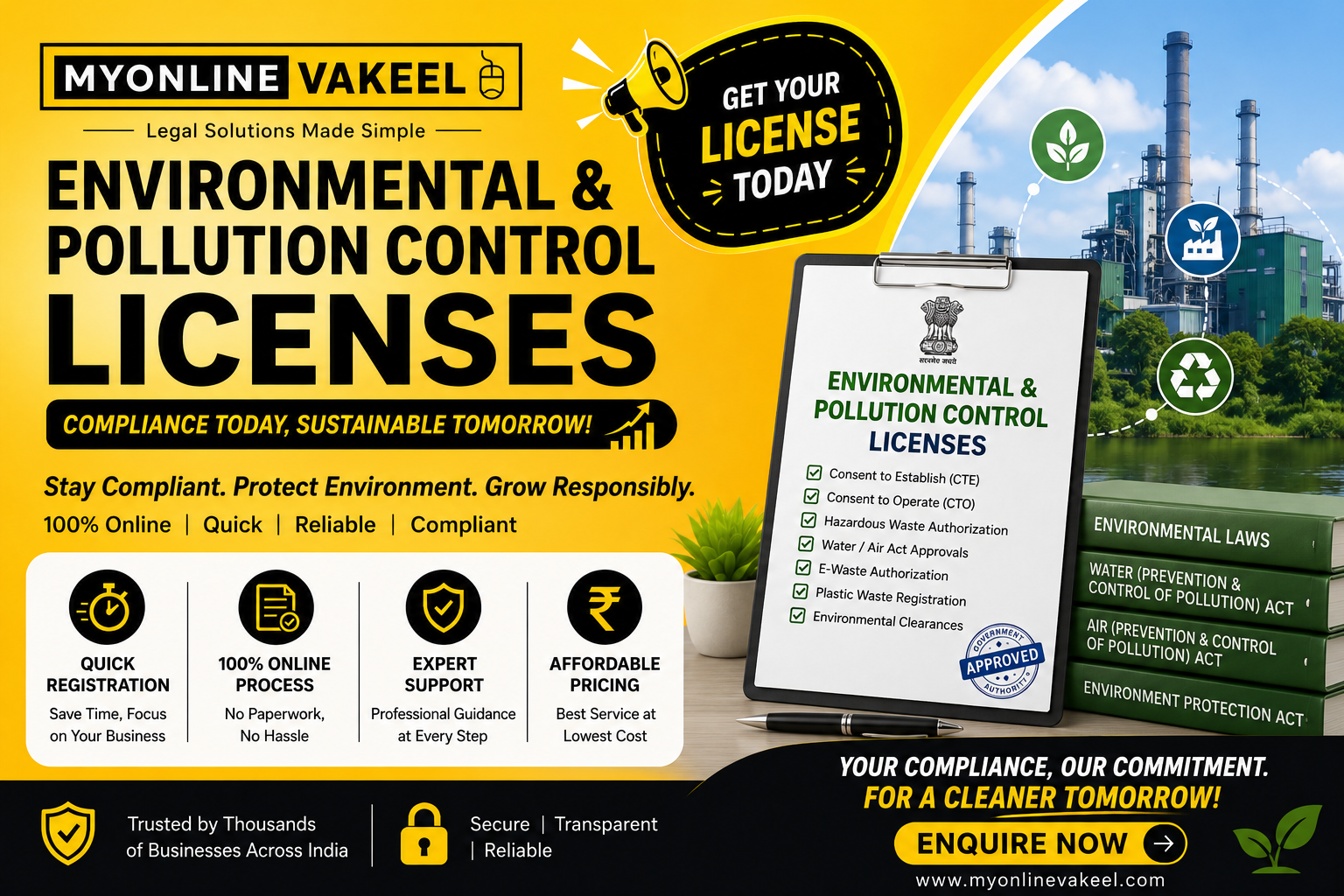
What
are Environmental & Pollution Control Licenses?
Environmental and Pollution Control Licenses
are mandatory approvals issued by the State Pollution Control Board (PCB) and
environmental authorities for industries, factories, and businesses that may
impact the environment. These licenses ensure compliance with environmental
laws and pollution control standards.
Why
are Pollution Control Licenses required?
These licenses are required to regulate
industrial pollution and protect the environment from harmful emissions, waste
disposal, water pollution, air pollution, and hazardous substances.
Who
needs Environmental & Pollution Control Licenses?
1.
Manufacturing
industries
2.
Factories
and industrial units
3.
Chemical
industries
4.
Food
processing units
5.
Pharmaceutical
companies
6.
Mining
and construction businesses
7.
Hospitals
and biomedical waste generators
8.
Plastic
and recycling industries
9.
Hotels
and commercial projects
Types
of Environmental & Pollution Licenses
1. Consent
to Establish (CTE)
Required before setting up any
industrial unit or project.
2. Consent
to Operate (CTO)
Required before commencing
business operations after installation/setup.
3. Hazardous
Waste Authorization
Required for handling, storage,
transportation, or disposal of hazardous waste.
4. Biomedical
Waste Authorization
Applicable to hospitals, clinics,
laboratories, and healthcare facilities.
5. E-Waste
Authorization
Required for businesses dealing
with electronic waste management.
Benefits of Pollution
Control Licenses
1.
Legal
approval to operate industrial/business activities
2.
Compliance
with environmental laws
3.
Avoidance
of penalties and closure notices
4.
Safe
waste and pollution management
5.
Enhances
business credibility and sustainability
6.
Required
for factory and industrial approvals
7.
Smooth
inspections and government clearances
Documents
Required
1.
PAN
Card and Aadhaar Card of applicant
2.
Business
registration documents
3.
Factory/industry
address proof
4.
Land
ownership/rent agreement documents
5.
Project
report
6.
Manufacturing
process details
7.
Water
and air pollution control details
8.
Layout
plan/site plan
9.
Electricity
bill
10. Factory license documents (if
applicable)
Penalty for Non-Compliance
Operating without environmental
approvals may result in:
1.
Heavy
penalties and environmental fines
2.
Closure
of factory or business operations
3.
Legal
action by Pollution Control Board
4.
Seizure
of industrial activities/equipment
5.
Prosecution
under environmental laws
Process
of Obtaining Pollution Control Licenses
1.
Assessment
of business category and pollution level
2.
Preparation
of project and technical documents
3.
Online
application filing with Pollution Control Board
4.
Inspection
by authorities (if required)
5.
Verification
and approval
6.
Issuance
of Consent/Authorization Certificate
Validity of Licenses
The validity of CTE, CTO, and other
environmental approvals depends on the type and category of industry and must
be renewed periodically as per government regulations.
Why
Choose MyOnlineVakeel?
MyOnlineVakeel
provides complete assistance for Pollution Control Board approvals including
CTE, CTO, hazardous waste authorization, compliance support, documentation,
application filing, and department follow-ups for smooth and legally compliant
approvals.
Contact Us
MYONLINEVAKEEL
Bhopal, Madhya Pradesh
Contact: 9669999037
Email: MYONLINEVAKEEL555@GMAIL.COM
Frequently Asked Questions
1. What
is an Environmental & Pollution Control License?
It is a mandatory approval required for businesses that may impact the
environment, ensuring compliance with pollution control and environmental
protection regulations issued by the Central Pollution Control Board.
2. Who
needs an Environmental & Pollution Control License in India?
Manufacturing units, factories, chemical industries, food processing units,
hospitals, construction projects, and businesses generating waste or emissions
generally require this license.
3. Why is
Pollution Control License important?
It helps businesses operate legally, protects the environment, ensures waste
management compliance, and prevents penalties from environmental authorities.
4. What
are the main types of Pollution Control approvals?
The major approvals include:
- Consent to Establish (CTE)
- Consent to Operate (CTO)
- Hazardous Waste
Authorization
- Environmental Clearance
- Waste Management
Authorization
4.
Is
Pollution Control approval mandatory for all businesses?
No. It mainly applies to industries or businesses that
generate waste, emissions, hazardous substances, or have environmental impact
based on industry category.
6.
How long does it take to obtain Pollution Control approval?
The process generally takes 15–45 working days, depending
on the industry type and approval from the respective pollution control
authority.
7.
What happens if a business operates without Pollution Control approval?
The business may face heavy penalties, legal action,
closure notices, cancellation of operations, or prosecution under environmental
laws.
8.
Which authority issues Pollution Control Licenses?
Licenses are generally issued by the State Pollution
Control Board of the respective state along with guidelines from the Central
Pollution Control Board.