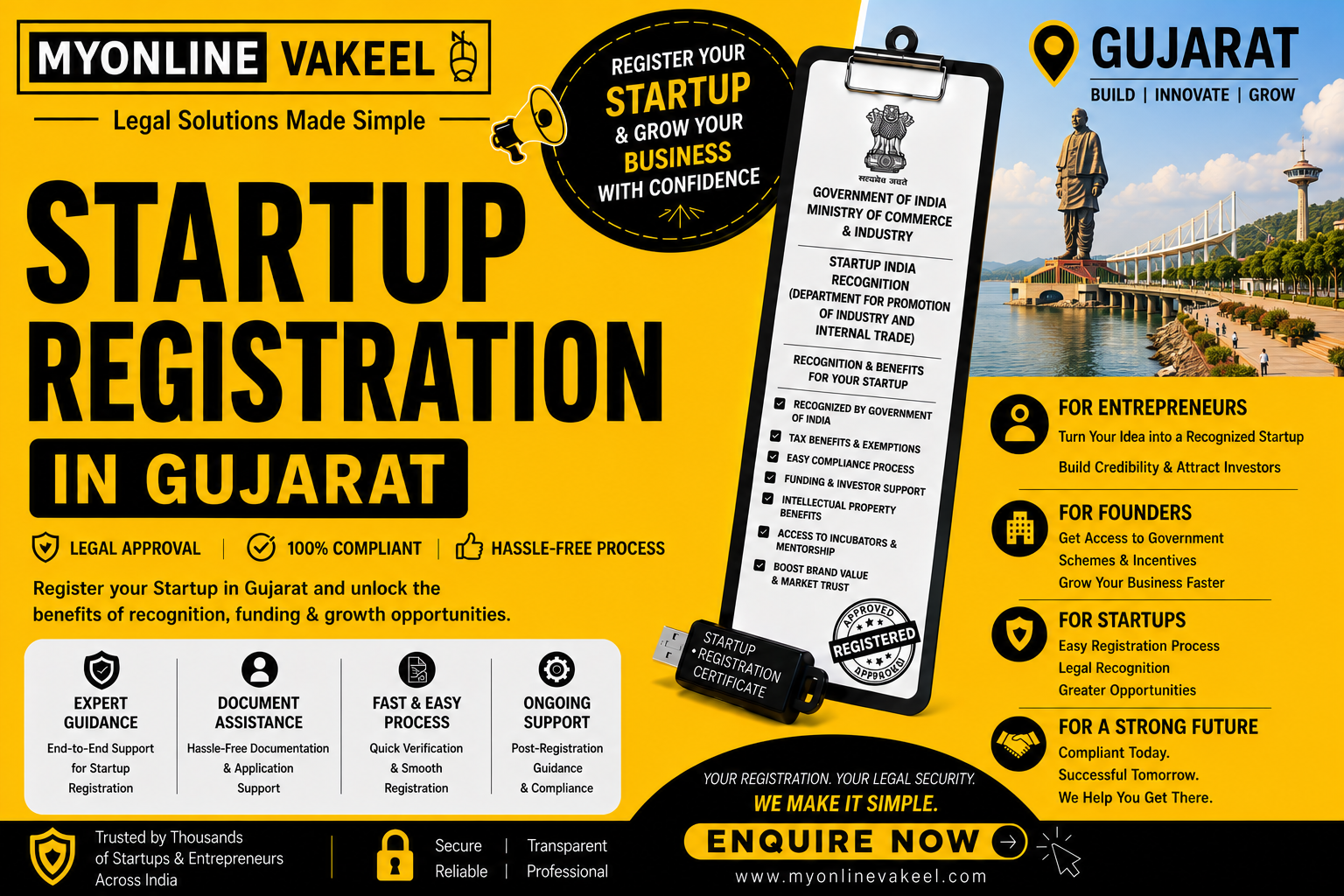
Startup Registration
Gujarat
How to Register Your Startup Under Startup
India and the Scheme for Assistance to Startups/Innovation (under Gujarat
Industrial Policy 2020) and Student Startup and Innovation Policy (SSIP 2.0,
valid 11 January 2022 – 31 March 2027)
Starting a business in India today means two
layers of registration are worth understanding: the central DPIIT (Startup
India) recognition that applies uniformly across the country, and your state's
own Startup Policy, which layers on additional funding, subsidies, and market
access specific to where your business is based.
My Online Vakeel provides complete,
end-to-end assistance for startup registration in Gujarat — covering both your
central DPIIT recognition and your Gujarat state-level benefits — so you don't
miss out on funding, tax exemptions, or subsidies you're entitled to.
Central DPIIT Startup
India Recognition — The Foundation Layer
Startup India is a flagship Government of
India initiative, launched on 16 January 2016 and administered by the
Department for Promotion of Industry and Internal Trade (DPIIT) under the
Ministry of Commerce and Industry. DPIIT recognition is a free, one-time
certification that confirms your entity qualifies as a 'startup' — it is a
recognition layer on top of your existing company, LLP, or partnership, not a
substitute for incorporation.
DPIIT Eligibility
Criteria
l Entity type: Private Limited Company, Limited Liability Partnership
(LLP), Registered Partnership Firm, Cooperative Society, or Multi-State
Cooperative Society. Sole proprietorships and HUFs are not eligible.
l Age of the entity: up to 10 years from the date of incorporation
(extended to 20 years for the newly introduced Deep Tech category — startups
working on fundamental scientific/technological breakthroughs such as AI,
biotech, quantum computing, space tech, or advanced materials).
l Annual turnover: less than ₹200 Crore in any financial year since
incorporation (raised from the earlier ₹100 Crore limit), with a higher ₹300
Crore cap for Deep Tech startups.
l The entity must not have been formed by splitting up or reconstructing
an existing business.
l The entity must be working towards innovation, development, or
improvement of products, processes, or services, or have a scalable business
model with high potential for employment generation or wealth creation.
l These criteria reflect the updated framework under DPIIT notification
G.S.R. 108(E), dated 4 February 2026, which raised the turnover ceiling, added
Cooperative Societies as an eligible entity type, and introduced the dedicated
Deep Tech category. Eligibility criteria are reviewed periodically, so we
always confirm the current notification before filing.
DPIIT Recognition
Process
Step 1 — Incorporate Your Entity
Register as a Private Limited Company, LLP, Registered
Partnership Firm, or Cooperative Society — DPIIT recognition can only be sought
after incorporation, not instead of it.
Step 2 — Create Your Profile
Sign up on the Startup India portal
(startupindia.gov.in) or the National Single Window System (nsws.gov.in), where
the application can be added under 'Central Approvals → Registration as a
Startup'.
Step 3 — Prepare Your Innovation Write-Up
Draft a clear, specific write-up (typically
up to 2 pages) explaining what makes your product or service innovative, how it
solves a real problem, and its scalability potential — vague or generic
write-ups are the single biggest cause of rejection.
Step 4 — Upload Documents
Certificate of Incorporation/Registration,
PAN of the entity, the innovation write-up, and (optionally) a pitch deck,
website/app links, or letters of recommendation from an incubator or
SEBI-registered investor.
Step 5 — Submit and Track
Submit the application online — a
system-generated acknowledgement number is issued immediately, and status can
be tracked on your dashboard.
Step 6 — Receive Your DPIIT Certificate
Straightforward, complete applications are
typically processed within 1–3 working days; applications needing clarification
can take 7–15 working days.
Key Benefits of DPIIT
Recognition
Section 80-IAC income tax exemption: a 100% profit
deduction for any 3 consecutive financial years out of the first 10 years since
incorporation (applied for separately, after DPIIT recognition, via the
Inter-Ministerial Board — this review typically takes 45–90 days).
No angel tax exposure: Section 56(2)(viib) of the Income
Tax Act, which taxed share premium above fair market value, was abolished with
effect from 1 April 2025 under the Finance Act, 2024 — this now applies to all
investors regardless of DPIIT status, though DPIIT recognition remains
necessary for the other benefits listed here.
Self-certification under 9 labour laws and 3 environmental
laws, reducing routine inspection burden.
80% rebate on patent filing fees and 50% rebate on
trademark filing fees, with fast-tracked examination.
Exemption from Earnest Money Deposit (EMD) and prior
turnover/experience requirements when bidding on government tenders via GeM.
Access to the Credit Guarantee Scheme for Startups (CGSS),
offering credit guarantees of up to ₹10 Crore, and to SIDBI's Fund of Funds,
which invests equity into SEBI-registered Alternative Investment Funds that in
turn back startups.
Fast-track winding up: eligible startups with simple debt
structures can be wound up within 90 days under the Insolvency and Bankruptcy
Code, 2016.
Gujarat State Startup
Policy — Additional Benefits
Nodal Agency: Startup Gujarat Cell /
Education Department (for the Student Startup and Innovation Policy)
Portal: Startup Gujarat Portal and SSIP
(Student Startup and Innovation Policy) Portal (startup.gujarat.gov.in /
ssipgujarat.in)
Policy: Scheme for Assistance to
Startups/Innovation (under Gujarat Industrial Policy 2020) and Student Startup
and Innovation Policy (SSIP 2.0, valid 11 January 2022 – 31 March 2027)
Status: Notified and active (two
complementary tracks: general startup assistance and the
student/academia-focused SSIP)
Why Gujarat's Startup
Policy Matters
Gujarat runs a distinctive dual-track model: the general
'Scheme for Assistance to Startups/Innovation' for individuals, groups, and
institutions, alongside SSIP 2.0, which specifically channels support through
universities, colleges, and even schools (Class 9–12) as the entry point for
young innovators.
Under SSIP 2.0, school students (Class 9–12) can access up
to ₹20,000 per proof-of-concept/prototype, while higher and technical education
students can access up to ₹2.5 Lakh per PoC/prototype — a rare, formally
structured pipeline from school-level ideas to funded projects.
IPR support under SSIP 2.0 is comprehensive and itemised:
up to ₹75,000 for domestic patents, ₹1.5 Lakh for international patents, ₹8,000
for copyrights, ₹12,500 for trademarks, ₹50,000 for international registration
of marks, ₹9,000 for industrial design, and ₹33,000 for plant variety registry
— covering up to 100% of eligible expenses.
SSIP 2.0 operates through a 'hub-and-spoke' model
integrated via the UDAYAM COGENT digital platform, which assigns a unique
identifier to stakeholders and tracks KPIs in real time.
For non-student/general startups, the Scheme for Assistance
requires the supporting institution (university, incubator, PSU, R&D
institution) to be a registered non-profit under Section 8 of the Companies
Act, 2013, with dedicated space and full-time staff — a structural safeguard
ensuring institutional accountability.
The complementary Atmanirbhar Gujarat Scheme provides
MSME-focused support, subsidies, and easier credit access for startups that
later need to scale manufacturing or service operations.
Eligibility for
State-Level Benefits
For the general Scheme for Assistance: any
individual/group with an innovative idea, or an eligible institution
(university, incubator, PSU, R&D institution, or private establishment) as
approved by the Policy Implementation Committee. For SSIP 2.0: the
institution/university/school must be based in Gujarat, and (for
universities/institutes) demonstrate a track record or strong commitment to
innovation and entrepreneurship.
Documents Required
l DPIIT recognition certificate, where the startup is also seeking
central Startup India benefits alongside Gujarat's schemes
l Proposal depicting the detailed action agenda, timeline and
deliverables (for institutional applicants under the general scheme)
l Nodal Institution registration/recommendation, since Gujarat's
registration process requires proposals to be submitted through a registered
Nodal Institution
l IPR-related invoices and receipts, for reimbursement claims under SSIP
2.0
l For Section 8 non-profit institutions: registration certificate under
the Companies Act, 2013
Gujarat Registration
Process
Step 1 — Secure DPIIT Recognition
Complete central DPIIT recognition for
entities seeking to combine national Startup India benefits with Gujarat's
schemes.
Step 2 — Identify Your Track
We determine whether the general Scheme for
Assistance (via Startup Gujarat) or SSIP 2.0 (via an academic/school Nodal
Institution) is the right fit based on your founder profile.
Step 3 — Register on the Relevant Portal
Sign up and create your Startup Gujarat Login
(for the general scheme) or submit your Student Startup/Innovation Proposal
through your Nodal Institution (for SSIP 2.0).
Step 4 — Submit Your Proposal
The proposal, along with supporting
technical/financial feasibility documentation, is submitted through the
registered Nodal Institution.
Step 5 — Committee Evaluation
The Policy Implementation Committee (general
scheme) or the relevant SSIP grant-review process evaluates the proposal
against policy KPIs.
Step 6 — Grant/Assistance Disbursement
On approval, funding is disbursed per the
applicable component (PoC/prototype grant, IPR reimbursement, or institutional
grant), and progress is tracked via the UDAYAM COGENT platform where
applicable.
Important to Know
⚠️ Gujarat's IPR support and student grants
are itemised and capped per category (patents, copyrights, trademarks, etc.)
rather than offered as one lump sum — so it's worth mapping your specific IP
filings against the itemised caps before assuming a single combined
reimbursement figure.
Why Choose My Online
Vakeel?
✅ DPIIT Recognition Filing — innovation write-up drafting,
document preparation, and application filing on the Startup India / NSWS portal
✅ Gujarat State Scheme Mapping — identifying every scheme,
fund, or subsidy you actually qualify for under the Scheme for Assistance to
Startups/Innovation (under Gujarat Industrial Policy 2020) and Student Startup
and Innovation Policy (SSIP 2.0, valid 11 January 2022 – 31 March 2027)
✅ Section 80-IAC Tax Exemption Application — preparing and
filing your Inter-Ministerial Board application after DPIIT recognition
✅ IPR Fee Rebate Filing — patent and trademark rebate
applications, coordinated with your recognition status
✅ Ongoing Compliance Support — tracking turnover/age
eligibility so your recognition doesn't lapse unnoticed
✅ Policy Monitoring — flagging new state scheme windows, deadlines, and
notifications (especially useful in states with evolving or draft policies)
Whether you're incorporating for the first
time or already running an established company, My Online Vakeel ensures your
Gujarat startup registration — both central and state layers — is handled
accurately and completely.
Frequently Asked
Questions
Is DPIIT recognition the same as company
incorporation?
No, they are two separate processes. You must
first incorporate as an eligible entity, and DPIIT recognition is a
certification layer applied for afterward.
Is there a government fee for DPIIT
recognition?
No, DPIIT recognition and the Section 80-IAC
application are both free of any government fee. Any fee you pay is for
professional/consulting assistance, not the government process itself.
Does DPIIT recognition expire?
It isn't permanent — recognition lasts as
long as you continue to meet the eligibility criteria (age and turnover limits).
If you cross the turnover cap or age limit, you exit the scheme automatically.
Can a sole proprietorship get DPIIT
recognition?
No, only Private Limited Companies, LLPs,
Registered Partnership Firms, and Cooperative/Multi-State Cooperative Societies
are eligible; sole proprietorships must convert to one of these structures
first.
What's the difference between the general
Scheme for Assistance and SSIP 2.0?
The general scheme supports individuals,
groups, and institutions broadly; SSIP 2.0 is specifically structured around
schools, colleges, and universities as the entry point for student innovators.
Can school students really get startup
funding in Gujarat?
Yes, Class 9–12 students can access up to
₹20,000 per proof-of-concept/prototype under SSIP 2.0, a distinctive feature of
Gujarat's approach.
Is there a cap on Gujarat's IPR
reimbursement?
Yes, reimbursement is itemised by IP category
(e.g., up to ₹75,000 for domestic patents, ₹8,000 for copyrights), rather than
a single blanket cap.
Do I need to apply through an institution?
For SSIP 2.0 and much of the general scheme,
yes — proposals are typically routed through a registered Nodal Institution,
incubator, or eligible educational body.
Get Your Gujarat Startup Registered with My
Online Vakeel
Contact My Online Vakeel today to begin your
DPIIT recognition and Gujarat state startup registration with confidence.
Why
Choose MyOnlineVakeel?
MyOnlineVakeel provides complete assistance for various statutory
registrations and licenses including document preparation, application filing,
department coordination, compliance support, and renewal services. We ensure
smooth, professional, and legally compliant registration services.
Contact
Us
MYONLINEVAKEEL
Bhopal,
Madhya Pradesh
Contact:
9669999037
Email:
MYONLINEVAKEEL555@GMAIL.COM